The Compounding Losses: Sea Buckthorn, GI-Tagged Produce and the Tourism Economy
The hardiness map told half the story. The other half sits in a single shrub being exported for nutraceutical oil, eleven GI-tagged products whose origin is itself climate-defined, and a Rs 19,000 crore tourist economy that has lost Rs 46,000 crore to extreme weather in five years.
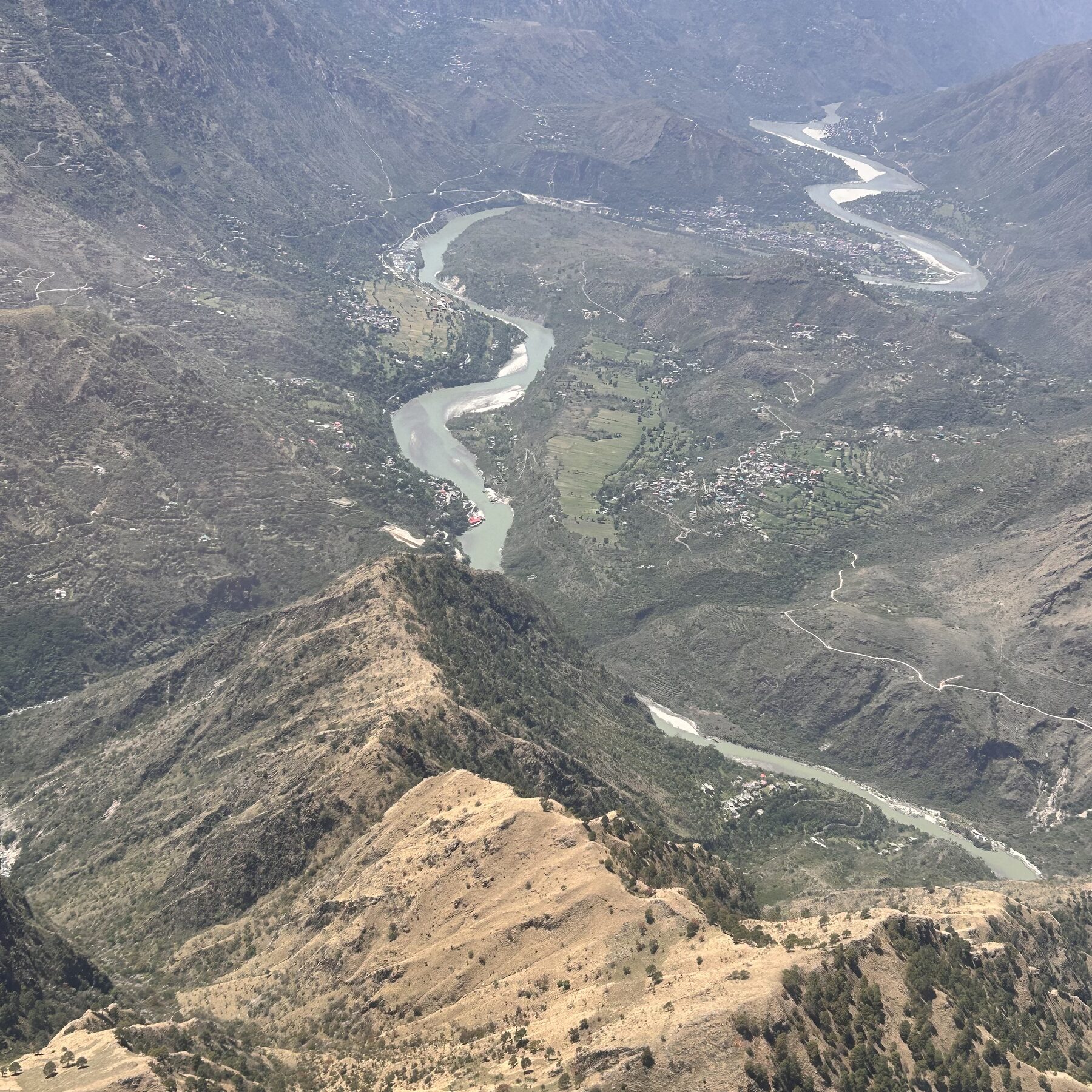
My earlier produce map omitted Hippophae rhamnoides, known locally as chharma or drilbu and commercially as sea buckthorn or Leh berry. This was an error of exclusion, not emphasis. Sea buckthorn is materially one of the most important commercial crops of Himachal's cold desert economy, and its exclusion from the portfolio map understated the diversification play. This briefing corrects that and, in the process, extends the analysis into two areas the earlier pieces did not fully quantify: the specific vulnerability of Himachal's eleven GI-tagged products, and the compounding economic losses as climate impact hits tourism and horticulture simultaneously.
Himachal Pradesh has suffered Rs 46,000 crore in losses from extreme weather events in the past five years, per the Tribune's December 2025 analysis of HP State Disaster Management Authority data. The 2023 monsoon alone caused a total loss of Rs 9,042 crore, with the state CM's assessment reaching Rs 10,000 crore including public and private assets (Wikipedia compendium of official figures). Tourism, which contributes approximately 7 to 7.5 percent of state GDP and supports over 300,000 livelihoods, recorded its lowest-ever influx of just 5 percent of normal capacity in the worst weeks of July 2023. Sea buckthorn demand from domestic industry is projected to reach 5,000 tonnes per year by 2025, with Himachal currently supplying only a fraction of that as 80 percent of raw material is imported from Pakistan and China. The state has 11 GI-tagged products, of which at least 4 are directly dependent on climate-specific agricultural origin.
The Himachal story is no longer about a single commodity breaking. It is about three compounding exposures hitting the same economy simultaneously. The hardiness squeeze I mapped earlier explains what is happening to apples, tea, trout and dairy on the production side. But the state is also losing the physical infrastructure it needs to get that produce to market and to host the tourists who anchor roughly 7 percent of its GDP. Those losses compound. A disrupted July monsoon does not just damage an apple crop. It shuts the highway that apples travel on, evacuates 70,000 tourists in a single week, washes out the hotels in Kullu and Mandi, and removes the hydropower revenue that offsets the agricultural shortfall.
This briefing adds three things to the earlier analysis. First, I restore sea buckthorn to the produce portfolio as the correction it deserves: the single most strategically interesting crop in Himachal's climate-adaptation story, growing precisely in the cold desert zones that are now becoming the state's new agricultural frontier. Second, I map the eleven GI-tagged products against their climate vulnerability, because a GI tag locks a product to a specific geography, which means climate-driven geographical shift either destroys the GI or requires the boundary to be re-drawn. Third, I quantify the tourism dependence, the ten-year arrival pattern, and the extrapolation of disaster losses forward to 2030.
Sea buckthorn: the cold-desert crop that climate policy has been ignoring
Hippophae rhamnoides is a deciduous shrub native to Himachal's trans-Himalayan cold deserts of Lahaul-Spiti and Kinnaur, with species variants across altitudes of 2,700 to 4,200 metres. Locally known as chharma or drilbu, and commercially marketed as Leh berry, the plant has been used for centuries in Amchi and Tibetan medicine. Every part is commercially useful: berries yield juice and oil, leaves make tea, twigs and roots are used in traditional medicine, and the plant itself is a nitrogen-fixer that stabilises fragile mountain soil.
The commercial case is significant. Berries contain 500 to 909 mg of Vitamin C per 100g, roughly 15 to 25 times the content of oranges. The plant contains 190 nutrients including Omega 3, 6, 7 and 9, with Omega-7 nearly unique to this source. DIHAR (the DRDO's Defence Institute of High Altitude Research) developed juice technology that resists freezing in Siachen conditions. The Indian Army has sourced sea buckthorn products to support high-altitude deployment adaptation, validated by studies from the Defence Institute of Physiology and Allied Sciences.
A Geographical Indication is a legal instrument that locks a product to a specific place. The logic is that the qualities of Kangra Tea or Chamba Rumal come from the soil, climate, water and human skill of that exact geography. That logic becomes a vulnerability under climate change. If the climate envelope of Kangra valley shifts outside the range that produces Kangra Tea's distinctive nutty, woody, catechin-rich profile, the product is either lost or the GI boundary has to be redrawn. Neither outcome is costless. The state has eleven GI-tagged products, of which four are direct agricultural produce, two are animal-fibre based, and five are handicrafts with indirect climate exposure through raw material supply.
| GI product | Category | Climate exposure mechanism | Risk tier |
|---|---|---|---|
| Kangra TeaGI 2005, EU GI 2023 | Agricultural | Yield falls 4 percent per 1 degree Celsius above 28. Dhauladhar altitude belt (900-1,400 m) increasingly heat-stressed. Monsoon variability affects flush timing. | Critical |
| Himachali BasmatiGI 2010 (joint North India) | Agricultural | Paonta valley production dependent on monsoon rhythm. Heat stress during grain fill reduces yield. Water stress during tillering. | High |
| Himachali Kala ZeeraGI 2019 | Agricultural | Native to 1,850-3,100 m in Kinnaur, Lahaul, Pangi. Lower boundary at risk; upper boundary may expand. Net range shift likely. | Moderate |
| Kinnauri Chulli OilGI 2019 | Agricultural processed | Wild apricot (Prunus armeniaca) needs chilling hours. Decline in low and mid-elevation belt already observed. Upper Kinnaur remains viable. | High |
| Kullu ShawlGI 2004 (first HP GI) | Handicraft (wool) | Indirect exposure via Gaddi and Rampur Bushair wool supply chain. Climate stress on alpine pasture compresses shearing and reduces fibre quality. | Moderate |
| Kinnauri Shawl (Chhali)GI 2008 | Handicraft (wool) | Pashmina and sheep wool supply chain exposure. Trans-Himalayan winter warming threatens fibre quality over medium term. | Moderate |
| Lahauli Socks and GlovesGI 2024 | Handicraft (wool) | Depends on cold-climate sheep wool from Lahaul-Spiti. Trans-Himalayan ecosystem warming directly affects raw material. | Moderate |
| Chamba RumalGI 2008 | Handicraft (embroidery) | Limited direct climate exposure. Indirect risk via tourism footfall at Chamba and handicraft market disruption during disaster years. | Stable |
| Chamba ChappalGI 2024 | Handicraft (leather) | Limited direct climate exposure. Market is tied to tourism; cancelled trips mean lost sales windows. | Stable |
| Kangra PaintingGI 2012 | Handicraft (art) | Market exposure only, via Kangra valley tourism. Cultural preservation independent of climate. | Stable |
| Kullu Shawl LogoGI logo, separate registration | Trademark | Legal identifier only; exposure identical to Kullu Shawl itself. | Moderate |
The four products I classify as Critical or High risk (Kangra Tea, Himachali Basmati, Kinnauri Chulli Oil, and the wool-based shawls through their supply chain) collectively represent the agricultural and pastoral backbone of Himachal's premium product identity in international markets. Kangra Tea is especially instructive: it secured European GI status in 2023, opening premium EU markets just as the production geography begins to struggle with the thermal ceiling I mapped in the hardiness brief. The legal victory and the climate vulnerability are running in opposite directions on the same product.
The underreported dimension is the handicraft-tourism dependency. Chamba Rumal, Kangra Painting, Chamba Chappal and the Kullu and Kinnauri shawls all sell primarily through tourist market channels. When the 2023 monsoon evacuated 70,000 tourists in a single weekend and tourist arrivals dropped to 5 percent of normal, these GI-tagged products lost their commercial window at the same moment. The climate event hits the producer and the buyer at once.
Tourism: the economy that climate is rewriting
Himachal's tourism economy has three distinctive features relevant to climate risk. First, it is seasonally concentrated: peak arrivals hit in May-June (summer escape) and December-January (snow tourism), with a pilgrimage layer around the Shakti Peeths running through July-September. Second, it is geographically concentrated: the five districts of Shimla, Kullu, Mandi, Kangra and Hamirpur account for roughly 55 percent of state arrivals. Third, the two seasonal peaks are the two windows that climate change is most aggressively disrupting. Summer is hit by extreme monsoon events. Winter is hit by declining snowfall.
The scale of the dependency is substantial. Tourism contributes approximately 7 to 7.5 percent of state GDP, supports over 300,000 livelihoods directly and indirectly, and anchors the consumer base for most of the state's GI-tagged handicraft segment. Total state GSDP for FY26 is estimated at Rs 2.55 trillion, which puts the tourism economy at roughly Rs 19,000 crore annually. In 2024, Himachal recorded 10 million arrivals in the first half of the year alone, of which 9.5 million were domestic and 500,000 foreign; the full year crossed the 1 crore mark.
The pattern matters. After COVID collapsed arrivals in 2020 and 2021, the sector recovered fully by 2022 and grew strongly into 2024. The 2023 monsoon disaster cut arrivals roughly in half during the three peak weeks of July, and the industry has not fully regained its 2022 trajectory despite apparent headline numbers. The recovery masks a structural vulnerability: each extreme weather event now removes a season's revenue for a large cohort of small and medium hotel, homestay, transport and guide operators.
The extrapolation embedded in that chart is the single most important number in this briefing for investors, DFIs and state planners. If the observed 2020-2025 compounding trend continues, Himachal Pradesh will absorb cumulative extreme-weather losses approaching Rs 1,00,000 crore (roughly USD 12 billion) by 2030. That figure is roughly equal to the state's entire current public debt stock, and roughly 40 percent of current annual GSDP. Even at a more conservative extrapolation, the state is on a trajectory where climate losses will exceed its realistic fiscal capacity to absorb without external financing or structural adaptation capex.
Where the compound effect hits hardest
When you overlay the crop hardiness map from my earlier briefing, the GI vulnerability matrix above, and the tourism disaster pattern together, three districts emerge as the compound-exposure centres. Kullu sits at the intersection of the apple belt collapse, off-season vegetable vulnerability, trout farming thermal stress, the Kullu Shawl GI supply chain, and peak summer tourism. Kangra holds Kangra Tea's climate-critical production zone, the Kangra Painting GI, and a growing share of lower-hill subtropical fruit cultivation exposed to monsoon variability. Mandi suffered the worst physical damage in 2023, with rainfall at 94 percent above the previous maximum, and it holds both vegetable production and a growing Shakti Peeths tourism arc. Policy capital and DFI adaptation financing should concentrate in these three districts first.
The sea buckthorn story cuts in a different direction. Lahaul-Spiti and Kinnaur, the districts most often described as vulnerable by virtue of their remote trans-Himalayan position, are in fact the clearest climate-adaptation opportunity in the state. They are the zones where the apple belt is migrating into, where sea buckthorn already grows wild, where saffron and heeng pilots are working, where Himachali kala zeera and hops have their natural range. These are the new agricultural frontier. Underinvestment in their processing infrastructure, cold chain, and market linkages is currently the single largest missed opportunity in HP's climate adaptation portfolio.
How this compounds for the investment and DFI case
The synthesis across my four TCD briefings on Himachal (the snowfall decline, the produce map, the hardiness cross-link, and this one) is that Himachal Pradesh represents an unusually clean case study of compound physical climate risk on a mountain state economy. The produce hardiness squeeze, the GI-tagged product vulnerability, the tourism disruption and the disaster losses are not four separate risks. They are four expressions of the same underlying driver, and they compound each other.
For development finance institutions (World Bank, ADB, JICA), the adaptation financing case is unusually strong because the marginal rupee has measurable yield-preservation and livelihood-protection value at the produce level, and separately has measurable infrastructure-protection value at the tourism and disaster-resilience level. The ADB's ongoing Sustainable and Inclusive Tourism Development Project in HP is pitched at exactly this logic.
For Indian corporates with BRSR disclosure obligations, Himachal is a useful physical risk case for supply chain due diligence. Companies sourcing tea, apples, medicinal plant extracts, handicrafts, or hydropower from the state should be building the compound-exposure view into their Materiality Assessment under SEBI's BRSR Core framework.
For Indian investors in agri-commodity, nutraceutical, hospitality and infrastructure sectors, the opportunity is in the climate-adaptation-compatible segments I have now mapped across four briefings: sea buckthorn processing, hemp supply chain from the 2026 licensing framework, aromatic crops, saffron, heeng, low-chill fruit varieties, and climate-resilient tourism infrastructure (homestays and experiential tourism rather than peak-season mass tourism). The state's own diversification policy is moving in this direction. Private capital is not yet following at scale.
Himachal will not lose its produce economy or its tourism economy. It will lose the current geography of both. The cost of that transition is rising faster than the state can absorb unaided, and the opportunity for aligned private and development capital is genuinely material. That, more than any single data point in any of these briefings, is the signal I would want a board-level reader to take away.